



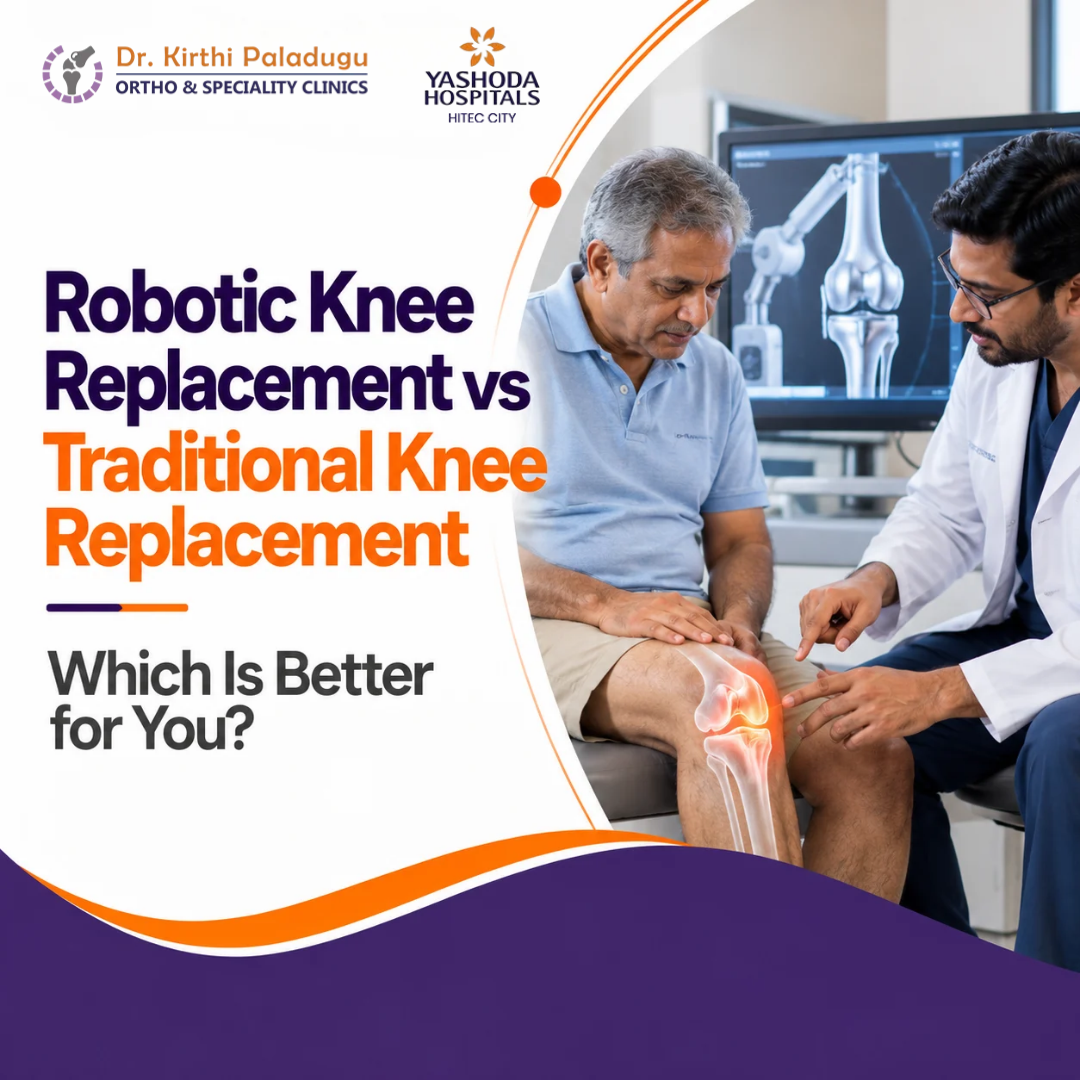
Knee pain can make everyday activities like walking, climbing stairs, sitting, and standing difficult. For people suffering from severe knee arthritis or joint damage, knee replacement surgery can help relieve pain and restore mobility.
With advancements in orthopedic technology, patients now have two surgical approaches to consider: traditional knee replacement and robotic-assisted knee replacement.
Both procedures aim to replace damaged knee joint surfaces with artificial implants. However, they differ in surgical planning, precision, and the techniques used to position the implant.
So, which procedure is better? Does robotic knee replacement offer faster recovery? Is it more accurate than traditional surgery?
Let's understand the differences to help you make an informed decision.
What Is Traditional Knee Replacement Surgery?
Traditional knee replacement, also known as conventional total knee replacement, is a well-established surgical procedure used to treat severe knee arthritis and joint damage.
During the procedure, an orthopedic surgeon removes the damaged cartilage and a small amount of underlying bone from the knee joint. These damaged surfaces are replaced with artificial components designed to restore smoother joint movement.
The surgeon uses specialized surgical instruments and alignment guides to position the implant.
Benefits of Traditional Knee Replacement
- Provides effective pain relief for patients with advanced knee arthritis.
- Helps improve walking ability and joint mobility.
- Has a long history of successful clinical outcomes.
- Can correct certain knee alignment problems.
- Is generally more affordable than robotic-assisted knee replacement.
Traditional knee replacement continues to be a reliable treatment option, especially when performed by an experienced orthopedic surgeon.
What Is Robotic Knee Replacement Surgery?
Robotic knee replacement is an advanced surgical approach that uses computer-assisted technology to help surgeons plan and perform knee replacement procedures with greater precision.
Unlike what many patients assume, the robot does not independently perform the surgery.
The orthopedic surgeon remains in complete control, while the robotic system assists with surgical planning, bone preparation, and implant positioning.
Depending on the robotic system, the technology may use preoperative imaging or real-time measurements to create a detailed digital model of the patient's knee.
This helps the surgeon understand the patient's joint anatomy and develop a personalized surgical plan.
How Does Robotic Knee Replacement Work?
1. Detailed Knee Assessment
The surgeon evaluates the patient's knee anatomy, joint damage, ligament condition, and alignment.
2. Personalized Surgical Planning
Computer-assisted technology helps determine suitable implant positioning and the bone cuts required during surgery.
3. Robot-Assisted Bone Preparation
The robotic system assists the surgeon in following the planned bone cuts with precision.
4. Implant Placement and Alignment
The artificial knee components are positioned, and the surgeon checks joint stability, movement, and balance.
This technology provides additional information that may help surgeons make precise adjustments during surgery.
Robotic Knee Replacement vs Traditional Knee Replacement: What Are the Main Differences?
Although both procedures aim to relieve pain and improve knee function, several differences are worth understanding.
1. Surgical Precision
Surgical precision plays an important role in knee replacement surgery.
Every patient's knee has a different shape, size, and alignment. These variations can influence implant positioning and the way the artificial joint moves after surgery.
In traditional knee replacement, surgeons use specialized instruments and their clinical expertise to prepare the bone and align the implant.
In robotic-assisted knee replacement, digital measurements and robotic guidance help surgeons execute a personalized surgical plan.
Why does surgical precision matter?
Accurate bone preparation and implant positioning can help support:
- Appropriate knee alignment.
- Balanced joint movement.
- Better joint stability.
- Consistent implant positioning.
- Proper functioning of the artificial knee.
Studies suggest that robotic-assisted knee replacement can improve the accuracy and consistency of implant alignment compared with conventional techniques.
However, greater surgical precision does not automatically mean better long-term outcomes for every patient.
2. Implant Positioning and Knee Alignment
Correct implant positioning is one of the important factors influencing knee replacement outcomes.
The artificial components must be placed in a way that supports comfortable movement, appropriate alignment, and joint stability.
With traditional knee replacement, surgeons rely on conventional alignment guides and surgical techniques.
Robotic-assisted surgery provides detailed measurements that can help surgeons plan and adjust the position of knee implants according to the patient's anatomy.
This may be particularly useful when the knee has alignment abnormalities or requires careful surgical planning.
However, both approaches can achieve accurate implant placement when performed appropriately.
3. Recovery Time After Surgery
Many patients considering knee replacement ask whether robotic surgery offers faster recovery.
Some research suggests that robotic-assisted knee replacement may provide early recovery benefits, including improvements in certain pain and mobility measures.
However, these findings are not consistent across all studies.
Recovery after either procedure depends on the patient's overall health, muscle strength, severity of arthritis, and commitment to rehabilitation.
General Recovery Timeline After Knee Replacement
First 24–48 Hours
Many patients begin standing and walking with assistance, depending on their medical condition and the surgeon's advice.
First 2 Weeks
Physiotherapy focuses on improving knee movement, reducing swelling, and supporting safe walking.
Weeks 3–6
Patients gradually become more comfortable with routine activities as strength and mobility improve.
Weeks 6–12
Many patients experience noticeable improvements in walking ability, joint flexibility, and confidence.
3–12 Months
Strength, comfort, and knee function may continue improving as the joint heals.
These are general milestones. Individual recovery times may vary considerably.
Whether the procedure is robotic or traditional, following the recommended physiotherapy and rehabilitation program is essential for a successful recovery.
4. Pain After Knee Replacement Surgery
Pain and swelling are normal during the initial recovery period following knee replacement.
Some studies suggest that robotic-assisted procedures may be associated with reduced early postoperative pain. However, the evidence is mixed, and not every patient experiences this benefit.
Both robotic and traditional knee replacement patients require appropriate pain management and rehabilitation.
The level of postoperative pain can also depend on individual pain sensitivity, surgical technique, anesthesia, and overall health.
5. Long-Term Results and Implant Lifespan
Patients often ask whether robotic knee replacement implants last longer than implants placed during traditional surgery.
Robotic technology can improve the accuracy of implant alignment, which is an important consideration in joint replacement.
However, current clinical evidence has not established that robotic-assisted knee replacement consistently results in longer implant survival.
Modern knee replacement implants can function successfully for many years with either surgical approach.
Implant longevity depends on factors such as:
- Implant design and material.
- Surgical technique and positioning.
- Patient weight and activity levels.
- Bone quality.
- Overall health.
- Postoperative rehabilitation.
The goal of both procedures is to provide lasting pain relief and improved mobility.
Who Is a Good Candidate for Robotic Knee Replacement?
Robotic-assisted knee replacement may be considered for patients who experience significant knee joint damage and have not received adequate relief from nonsurgical treatments.
You may be a candidate if you have:
- Severe knee osteoarthritis.
- Persistent knee pain while walking or climbing stairs.
- Difficulty performing everyday activities.
- Significant knee stiffness or reduced mobility.
- Knee deformities such as bow legs or knock knees.
- Joint damage that has not responded to medication, physiotherapy, or other treatments.
However, not every patient with knee arthritis requires surgery, and not every patient undergoing knee replacement needs robotic assistance.
An orthopedic surgeon will evaluate your symptoms, X-rays, medical history, and overall condition before recommending the most suitable treatment.
Is Robotic Knee Replacement Safer Than Traditional Surgery?
Both robotic-assisted and traditional knee replacement are established surgical approaches.
Like any major surgery, they involve certain risks, including:
- Infection.
- Blood clots.
- Joint stiffness.
- Persistent pain.
- Nerve or blood vessel injury.
- Implant-related complications.
Robotic-assisted surgery may also involve technology-specific considerations, depending on the system used.
Research generally suggests that overall complication rates are comparable between robotic-assisted and conventional knee replacement.
The safety of either procedure depends on appropriate patient selection, surgical expertise, medical preparation, and postoperative care.
Which Is Better: Robotic or Traditional Knee Replacement?
Both surgical approaches offer valuable benefits.
Robotic knee replacement may offer advantages in:
- Personalized surgical planning.
- Accurate bone preparation.
- Consistent implant positioning.
- Detailed assessment of knee alignment.
- Intraoperative measurements that help guide surgical decisions.
Traditional knee replacement offers advantages in:
- A long-established record of successful outcomes.
- Reliable pain relief and mobility improvement.
- Wider availability.
- Generally lower procedural costs.
- Proven effectiveness for advanced knee arthritis.
While robotic technology provides additional precision, it does not guarantee a faster recovery, completely pain-free surgery, or a longer-lasting implant.
The best approach depends on the patient's specific knee condition, overall health, expectations, and the orthopedic surgeon's assessment.
When Should You Consult an Orthopedic Surgeon for Knee Replacement?
Not every knee problem requires surgery. Many patients can manage knee pain through medication, physiotherapy, lifestyle modifications, and other nonsurgical treatments.
However, you should consider consulting an orthopedic specialist if:
- Knee pain continues despite treatment.
- Walking short distances becomes difficult.
- You experience severe pain while climbing stairs.
- Knee stiffness affects daily movement.
- Pain interferes with sleep or routine activities.
- Your knee appears increasingly bent or deformed.
- Your quality of life is significantly affected by knee arthritis.
An early orthopedic evaluation can help identify the cause of your symptoms and determine whether knee replacement surgery is necessary.
Consult Dr. Kirthi Paladugu for Knee Replacement Surgery in Hyderabad
If severe knee pain or arthritis is limiting your daily activities, consulting an experienced orthopedic surgeon can help you understand your treatment options.
Dr. Kirthi Paladugu, an orthopedic surgeon in Hyderabad, specializes in knee replacement surgery, including robotic-assisted total knee replacement.
Through a detailed orthopedic evaluation, Dr. Kirthi helps patients understand their knee condition and the available surgical and nonsurgical treatment options.
Whether robotic-assisted or traditional knee replacement is recommended, the focus remains on reducing pain, improving joint function, and helping patients regain mobility.
Book Your Consultation
📞 +91 9100049797 | +91 8096679797
🌐 www.drkirthipaladuguorthosurgeon.com
Frequently Asked Questions About Robotic and Traditional Knee Replacement
1. Is robotic knee replacement better than traditional knee replacement?
Robotic knee replacement offers greater precision in surgical planning and implant positioning. However, both procedures can provide good pain relief and improved mobility. The most suitable option depends on the patient's knee condition and the surgeon's evaluation.
2. Does a robot perform knee replacement surgery on its own?
No. The orthopedic surgeon performs and controls the surgery. The robotic system assists with surgical planning, measurements, and precise bone preparation.
3. Is robotic knee replacement less painful?
Some patients may experience less pain during early recovery, but research findings are mixed. Both procedures involve postoperative discomfort and require appropriate rehabilitation.
4. How soon can I walk after robotic knee replacement surgery?
Many patients can begin walking with assistance within 24 hours after surgery. The exact timing depends on their health, surgical recovery, and the orthopedic surgeon's recommendations.
5. Is robotic knee replacement suitable for elderly patients?
Robotic knee replacement may be suitable for older patients who are medically fit for surgery. Age alone does not determine eligibility. The surgeon considers overall health, joint condition, and other medical factors.
6. Is robotic knee replacement more expensive than traditional surgery?
Robotic-assisted knee replacement generally costs more because of specialized equipment and technology. The final cost depends on the hospital, implant, surgical requirements, and other factors.
7. How long does a robotic knee replacement implant last?
Robotic-assisted and traditional knee replacement implants can last for many years. Implant lifespan depends on several factors, and robotic technology has not yet been proven to consistently increase implant longevity.
8. How do I choose between robotic and traditional knee replacement?
An orthopedic surgeon can assess your knee X-rays, degree of arthritis, joint alignment, and overall health to recommend the most appropriate surgical technique.
Conclusion
Robotic and traditional knee replacement surgeries share the same primary goal: relieving chronic knee pain and improving mobility.
Robotic-assisted knee replacement offers technological advantages in surgical planning, precision, and implant positioning. Traditional knee replacement remains a proven and effective treatment option with a long history of successful outcomes.
The best knee replacement approach is not determined by technology alone. It depends on your knee condition, the surgeon's expertise, and the quality of your rehabilitation.
If you are considering knee replacement surgery in Hyderabad, consult Dr. Kirthi Paladugu to understand which approach may be suitable for your needs.
Medical Disclaimer: This article is for educational purposes only and should not replace professional medical advice. Consult a qualified orthopedic surgeon for personalized diagnosis and treatment recommendations.